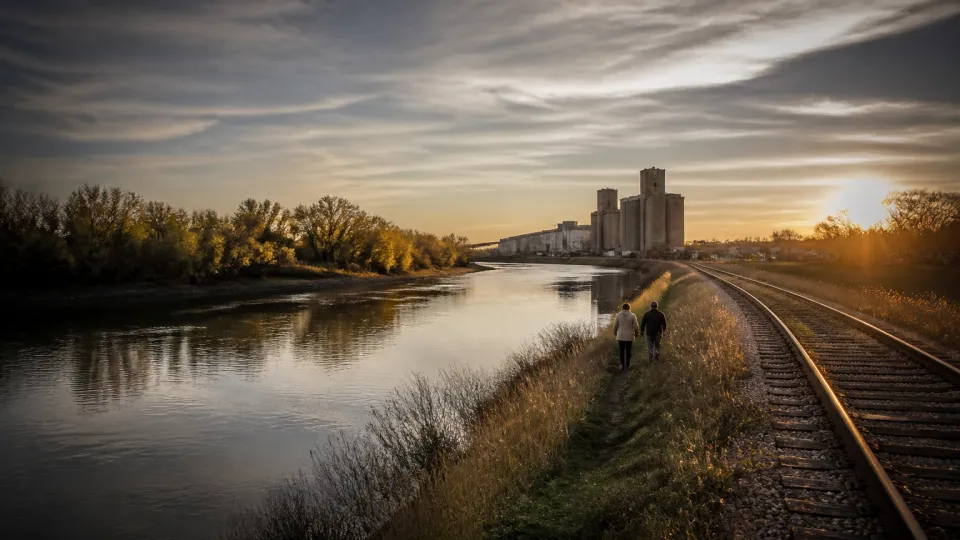
On an autumn morning the Assiniboine River runs low and honest through Brandon; beyond the bend, clinker-brick warehouses and the stubby silhouettes of old grain elevators stand like punctuation marks in a long sentence about movement—of people, of grain, of capital. Those structures, some repurposed, some gone, still anchor local memory. They are the physical traces of decisions made a century ago that continue to define how the Westman region negotiates change.
The story of Westman is often told through the blunt instruments of progress: rails laid across prairie, elevators built in town after town, and the steady, seasonal choreography of harvest trucks. Yet beneath that infrastructure are layered human stories: settlers and Indigenous families, soldiers stationed at Shilo, oil-field crews in Virden, teachers and nurses who stayed to build institutions. These are the people who turned geography into community, and who, in doing so, created a region that keeps reinventing itself.
The railroad’s arrival in the late 19th century created nodes around which commerce and towns grew. Brandon, positioned where the Assiniboine bends, became a hub. Grain elevators multiplied as the prairie’s wheat economy intensified; the skyline of small towns—Souris, Neepawa, Rivers—was defined by these wooden sentinels. For decades, the elevator was not merely a piece of machinery but the centre of civic ritual: commodity prices posted on boards, farmers gathering to compare yields, teenagers crossing tracks to evening dances.
Mid-20th-century shifts tested that model. Mechanization reduced farm labour, grain consolidation closed many local elevators, and global markets remade commodity math. Yet Westman’s response was not retreat but diversification. Military investment at CFB Shilo provided stable employment, the discovery of oil in areas around Virden in the mid-20th century added a new economic column, and educational institutions—Brandon University and community colleges—began to anchor talent locally. Health services expanded, too, and the region’s role as a service centre for surrounding rural areas deepened.
Those structural changes played out in human terms. Farmers who once carried boxes of seed by hand now shepherd fleets of GPS-enabled sprayers; a fifth-generation grain grower in the region told neighbours last year that adaptation is less a slogan than an occupational habit. Small entrepreneurs in Brandon’s downtown converted former warehouses into studios, microbreweries and co-working spaces, proving that repurposing can be both cultural and economic.
Indigenous presence—Anishinaabe, Dakota and Métis communities—has always been foundational even when it was marginalized in official accounts. Contemporary efforts toward reconciliation and partnership are changing relationships across the region. Collaborative agricultural projects, cultural programming in schools, and joint stewardship of river corridors point to a development model that values place-based knowledge as much as technical expertise.
Climate change now reframes historic questions. Westman’s economy is still tied to weather: a late frost, an unusual drought, or intense spring runoff can ripple through supply chains and household budgets. Local adaptation is visible in practice—longer crop rotations, investment in soil health, community flood mitigation works—but also in governance: municipalities coordinating for emergency management, universities prioritizing applied research in resilient agriculture.
What binds these examples is a persistent pragmatism. Westman’s leaders have seldom chased grand gestures; they combine incremental investments with a willingness to pivot. The result is a layered region where a university research partnership might sit beside a family-run manufacturing plant, and where a community arts festival occupies a refurbished elevator loft.
There are real, difficult questions ahead. Population aging in smaller towns, retaining youth after post-secondary education, ensuring equitable access to health care in remote hamlets—these are not abstract policy puzzles but lived realities for neighbours: a nurse balancing two jobs, a young teacher commuting an hour each way, an Indigenous entrepreneur trying to secure capital for expansion. Tackling these will require a blend of regional planning, targeted investment, and a cultural commitment to shared prosperity.
But the past suggests a workable ethic. Westman’s development has not been accidental; it has been the cumulative product of improvisation—of communities applying local knowledge to global pressures. Today’s task is to scale that ethic: use research from Brandon’s campuses to inform farm-level practice, combine provincial funding with local leadership for infrastructure that anticipates extreme weather, and center Indigenous stewardship in land-use decisions.
If the grain elevators taught one lesson, it is that structures endure only when they are useful. The region’s next century will be written by how well it reinvents usefulness—economically, culturally, and ecologically—without losing sight of the human labor and memory that have always made Westman more than a map of resources. The river keeps moving. So do the people alongside it, reworking the past into a viable future.