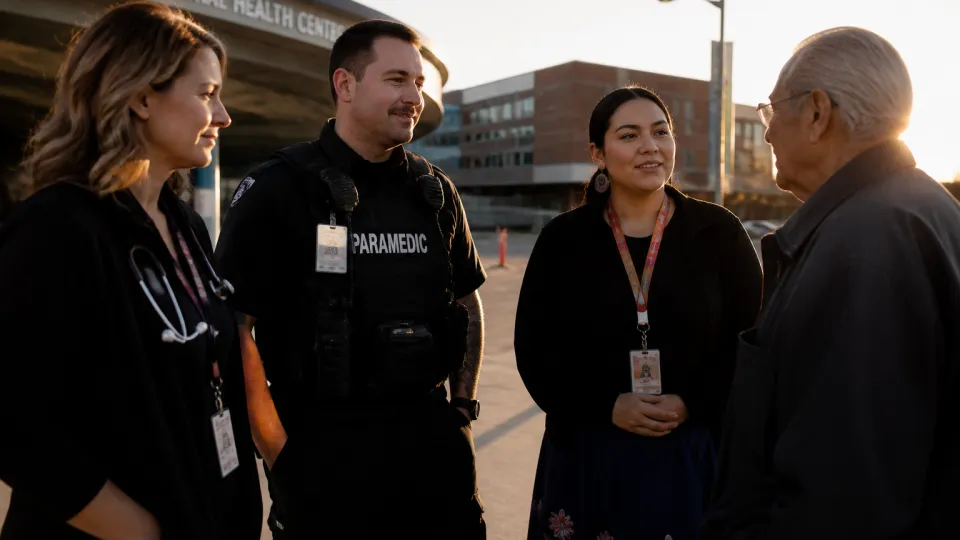
On a rain-thin morning outside the Brandon Regional Health Centre, a small white van pulls up and three people spill out — a nurse practitioner, a community paramedic and a liaison worker from the Brandon Friendship Centre. Their day will be a patchwork of home visits, a pop-up clinic in a church basement and a drop-in mental-health hour at a seniors’ residence. For many in Westman, this mobile team is the first consistent link to a health system that often feels remote and overburdened.
The image is modest but revealing. In the absence of enough family physicians and with hospital waitlists swelling, communities across southwestern Manitoba have quietly retooled how care reaches people. The innovations are uneven — driven by municipal funding, provincial policy gaps and the stubborn creativity of local health workers — but their impact is tangible: fewer missed appointments, earlier interventions for chronic illness and a nascent trust between Indigenous and non-Indigenous providers where mistrust has long lingered.
It is not a story of heroic fixes; it is a study in incremental repair. Prairie Mountain Health, the regional authority that serves Brandon and much of Westman, has supported extensions of nurse-practitioner clinics, telehealth capacity and community paramedicine programs. On the ground, organizations such as the Brandon Friendship Centre have led culturally safe outreach to Indigenous residents, ensuring that health messaging and services translate into action.
Consider a recent afternoon in the town of Virden. A community paramedic, equipped with diagnostic tools and a cell connection to a physician, visited Mr. L, a 72-year-old retiree who had struggled to see a family doctor after his clinic hours were cut. “We adjusted medication, taught him how to monitor symptoms, and prevented a likely ER visit,” the paramedic said. That single interaction is emblematic of a larger trend: shifting some acute and chronic care out of emergency departments and into community settings, where continuity is possible and marginal costs — time, travel, anxiety — are lower.
Mental health has been another area of experimentation. Brandon’s peer-support networks, bolstered by volunteers and small municipal grants, have expanded drop-ins and group therapy options. A mental-health worker described the paradox: while demand has risen, the community-based approach creates informal safety nets that formal systems can miss. “People come because they are known,” she said. “It’s not just about a clinician’s hour; it’s about someone remembering their name.”
Indigenous-led care initiatives have reshaped how services are delivered in urban and reserve contexts alike. The Friendship Centre’s outreach teams, often staffed by Indigenous workers, act as cultural bridges: accompanying clients to appointments, advocating at hospitals and running elders’ clinics that combine traditional healing with biomedical care. These programs underscore a simple fact of rural practice — trust is a treatment.
But for all the ingenuity, gaps remain. Recruitment is the elephant in every clinic waiting room. Rural Manitoba, like much of Canada, faces a workforce crunch: physicians nearing retirement, fewer medical trainees choosing rural practice and limited incentives for relocation. Telehealth has helped connect specialists in Winnipeg to patients in Westman, but connectivity problems and the limits of virtual physical exams mean telemedicine can't be the sole answer.
Funding structures amplify the problem. Short-term grants have catalyzed many pilot projects, yet is uncertain when municipal budgets tighten and provincial priorities shift. A program that reduces hospital admissions is a public good, but its financial benefits are distributed across institutions, complicating arguments for long-term investment by any single payer.
Still, there are reasons for cautious optimism. Local leaders are experimenting with interprofessional teams where nurse practitioners, paramedics, social workers and Indigenous navigators share responsibility for a panel of patients. These teams emphasize prevention — home safety checks, medication reconciliation, and early mental-health intervention — rather than episodic crisis care. Training pipelines are being nudged toward rural placements so that new clinicians develop roots in Westman, and recent policy discussions at the provincial level have begun to consider bundled, outcome-focused funding rather than line-by-line program grants.
If this region’s quiet experiment succeeds, the measure will not be shiny new facilities but the slow disappearance of stories about people falling through the cracks. It will be an elder who keeps living at home because a community paramedic adjusted their treatment plan; a young parent who gets culturally informed postpartum care from an Indigenous outreach worker; a town clinic that no longer closes when a physician retires because a team-based model shares responsibility.
None of this erases hard realities: demographic shifts, fiscal constraints and the entrenched urban pull of specialists. But the work in Westman suggests a pragmatic, humane way forward — less doctrinaire than ideology, more attentive than policy briefs. At the end of the mobile team’s day, as rain begins to thin and the van hums back toward Brandon, the paramedic reflects on a simple metric: fewer ER visits this week than last. It is a small victory, but in the slow arc of rural healthcare, small victories are exactly what stitch a system back together.